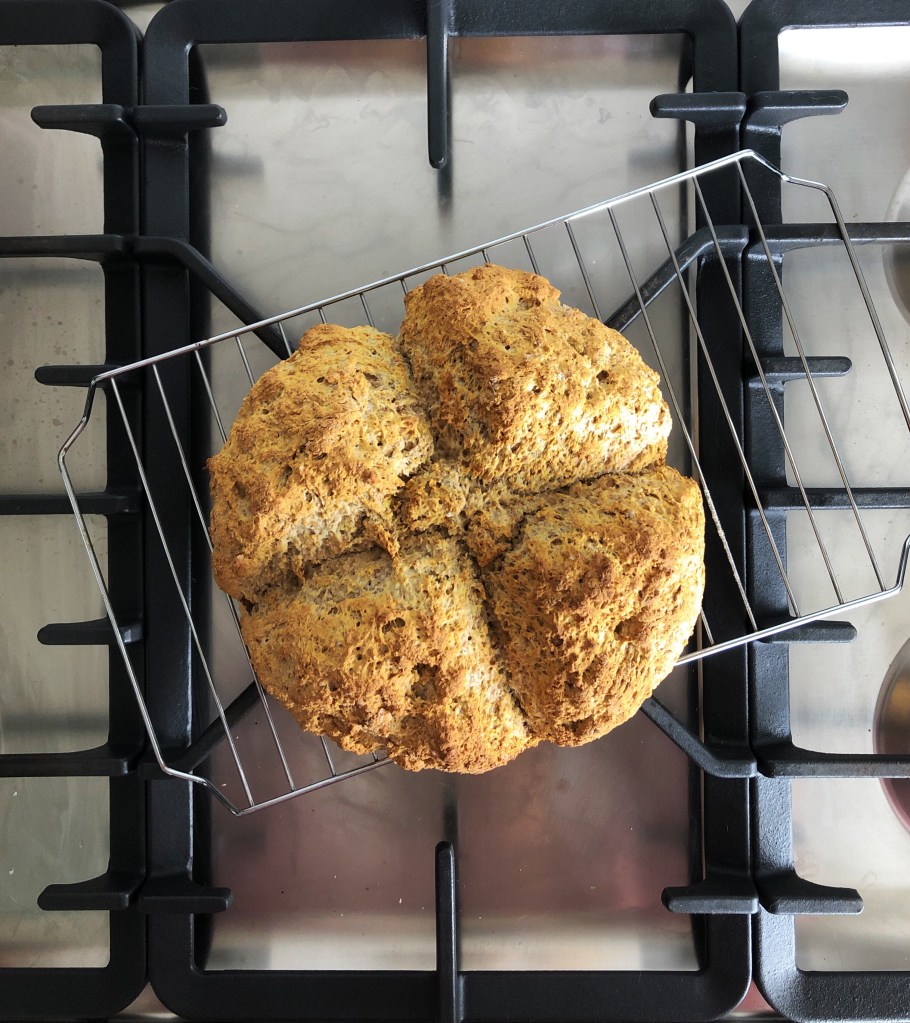
Contrary to some folk’s suspicion, I am not a vegan. I’m just trying to make plants feature more heavily in my eating life. I love traditional soda bread and this recipe is adapted from the traditional one I hold in my head.
I have used US style cup measures because it makes things very straightforward. Unlike the rest of what’s going on in the world right now.
The “cup” I use is in truth an old Hornsea Pottery mug, in the Bronte pattern (for enthusiasts), which holds about 250mL of liquid.
Seemingly in the 1970s, a mug of tea or more likely, a mug of coffee, given that loose leaf tea made in a teapot was the mode du jour, presented the drinker with a little bit of a briefer encounter than the ample mugs we buy today.
Contemporary mugs are around 300-400mL, or more, so either find a smaller one or measure up to a bit shy of the top. Hopefully the bread will still come up fine. That’s the kind of thing I would do. I’m a cook. An alchemist. Not a scientist.
In this recipe, there is no natural acid so you have to add it in. In the traditional recipe, the buttermilk contains lactic acid. I’ve also added a little fat too, which the buttermilk traditionally takes care of. If you want to, sprinkle a few oats or seeds on top before baking. Pumpkin seeds are my favourite and they’re chock full of minerals, vital elements. Like little crunchy green meteors, they are.
Using bicarbonate of soda as a leavening agent means no waiting for proving. The bread takes around 5 minutes to mix and just 30 minutes to cook. I could almost be bold enough to call it fast food, if I didn’t think it would upset the slow food movement I respect so highly.
Nowadays, soda bread is commonly associated with Ireland, yet many other countries and regions have a similar bread in their culinary wallpaper, one that is simple to make and leavened by soda. The collision of acid and bicarbonate is the key to the magic; forever blowing bubbles, pretty bubbles made of air.
NB. I bought a set of proper cup measures once upon a time and then ruined them in the dishwasher. Please don’t tell Ina Garten on me. Thanks.
INGREDIENTS
1.5 cups of wholemeal flour
1.5 cups of plain flour
1 teaspoon bicarbonate of soda
1 teaspoon salt
1 tablespoon sunflower oil
1 tablespoon white wine vinegar
1.25 cups of oat milk
METHOD
Heat the oven to 200C / gas mark 6.
Sprinkle flour over an oven tray.
In a large mixing bowl, combine all the dry ingredients together and mix well.
Stir the vinegar into the oat milk then add to the dry ingredients, with the oil, and bring all the ingredients together to form a sticky dough. It’s normal for the dough to be stuck to your fingers. Not like the dry and smooth consistency of a yeast bread.
Don’t knead the dough. As long as all the ingredients are evenly combined, you don’t need to vigorously mix the dough. The air bubbles will do a runner if you get too handy with the dough.
Place the dough onto the tray and shape into a round. Using a sharp knife, cut a deep cross into the bread, almost to the bottom, to ensure it cooks through in the middle. Place in the middle of the oven for 30 minutes until the top is golden brown. You can freeze this bread. I recommend letting it completely cool and then slicing it before freezing it then you can defrost just as much as you need.
 lightandwhistle